Sunday, February 3, 2013

Thompson's "Introduction to Merchants of Culture"


In the introduction to his book, Merchants of Culture, John B. Thompson examines the world of publishing, describing it as a “plurality of fields,” in which a field is a “structured space of social positions . . . occupied by agents and organizations” and where “the position of any agent or organization depends on the type and quantity of resources or 'capital' they have at their disposal.” Thompson describes why the notion of fields is a useful way of looking at the publishing world by saying that it first allows us to see that all publishing is not the same, where academic publishing can be dramatically different than another sector, such as trade publishing; secondly, it shows that the publishing industry is “fundamentally relational in character” where agents and organizations interact with each other and make decisions based on how they anticipate each other will act. Thirdly, it puts the focus on the capital at the disposal of the agents and organizations, reminding us that “power is not a magical property” but that it is “a capacity to act” based on the resources available to the agent or organization. The different types of capital involved in publishing are economic, human, social, intellectual, and symbolic. He says that all five are “vital to the success” of any publishing firm. Finally, he says that each field of publishing has what he calls “the logic of the field,” or “the set of factors that determine the conditions under which individual agents and organizations can participate in the field,” and that the logics of each publishing field is distinct from the other publishing fields.

Thompson then goes on to describe the publishing chain, which is a both a supply chain, in which the product is moved from the creator to the consumer, as well as a value chain, where each successive link in the chain is supposed to add value to the product. The ways a publisher adds value through his or her link, he says, is through six ways: content acquisition and list-building, financial investment and risk-taking, content development, quality control, management and coordination, and sales and marketing. Thompson ends his introduction by describing the hole in the scholarly discourse that his research and book fills, specifically, examining the publishing world with data from the present day and looking at the publishing world with a global perspective instead of focusing on only one country.

While Thompson's argument is valid, seeing publishing as a plurality of fields and describing why it is an important aspect in the book creation and sale process, I didn't find it particularly groundbreaking or novel, though his claims could be useful when defending the role of of the publisher at a time when anyone can go online and “publish” a work or writing.  If everyone is a potential publisher, wont that dilute the quality of content that gets published?

Historicizing Readers: Christine Pawley & "Seeking Significance"

Christine Pawley's article, "Seeking 'Significance:' Actual Readers, Specific Reading Communities," seeks to outline a process whereby historians can research, investigate, and analyze the reading habits of historical actors. This article originally appeared in the journal Book History in 2002, and Pawley writes that historians of the book and historians of reading need to "explore not only how we conceptualize the ideal reader but also how we can uncover the specific reading practices of actual readers" (page 143).
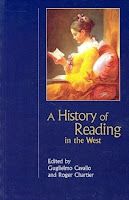
A History of Reading in the WestPawley asserts that reading is "first and foremost a social act," and she argues forcefully against the idea that reading is an individual activity, even though she recognizes that "the image of the lone reader still exercises a powerful hold on the imagination." (page 144). She critiques, for example, the cover of the, then-recently published, A History of Reading in the West, which featured a lone woman reading a book. Pawley maintains that the act of reading must be understood within its historical and social milieu and that people rarely choose, read, study, and understand texts on their own. 

Pawley's article challenges scholars of reading to investigate and identify the social groups that influenced people's reading decisions throughout history. Her aim, as she explicitly states, is to "show how, by conceiving of readers as members of a particular kind of reading community, historians can find a way not only to link those apparently disparate elements - readers and texts - but also to elaborate on who readers were, and thus to shed light on how these specific readers read" (page 144).

For Pawley, a reader's social environment represents one of the most important contributing factors to his or her reading choices. She takes an expansive view of such influences, defining "social" as "any interactive situation" including "informal interactions and groupings that may occur within institutions" (page 147). More specifically, she highlights the importance of what she calls "primary groups," which are the clubs, organizations, or cohorts to which a person belongs and which often profoundly affect a person's reading choices. Primary groups, she argues, frequently brought together people who had "shared habits and values," and, Pawley argues, "these groups provided the social... circumstances in which people interacted with printed materials" (page 150).

In the article, Pawley demonstrates her model by using historical data from two small midwestern communities to identify important primary groups that influenced the reading habits of particular groups of people.  She utilizes personalized 1890s circulation information from the Osage, Iowa public library, and anonymized 1950s circulation data from Wisconsin's Door-Kewaunee Regional Library to understand and analyze her subjects' reading choices.

Using the Osage High School class of 1899 as a primary group, Pawley demonstrates that the students who checked out books from the public library likely influenced each other's reading choices. By tracking the dates on which individual students borrowed specific titles or books by particular authors, she suggests that the students constituted an informal reading community, which shared information with one another. Interestingly, Pawley also uses the data to challenge the gendered assumptions that previous historians had made about the types of books that boys and girls read during the late nineteenth century.  Both of these insights demonstrate the strength of using preserved data with an understanding of reading's social context to make sense of the reading habits of particular people.

She similarly combines general circulation data with oral history interviews in Door and Kewaunee counties to show that homemakers' clubs associated with the local agricultural extension in the 1950s functioned as a primary group and most likely influenced the library borrowing habits of women in the area. Popular non-fiction books, like Henry Ahl's How To Beautify & Improve Your Home Ground, seemed to closely track the topics that the homemakers' clubs learned about and discussed.

In general, I found Pawley's thesis intriguing and convincing, but the reliance on library statistics in these two case studies tends to skew the data towards relatively affluent and middle-class populations. Along the same lines, both communities consisted of rural areas and small towns, and it would be interesting to consider whether these demographics affected the importance of primary groups to individual reading habits.  Pawley's model certainly seems to be extensible beyond middle class readers in the rural Upper Midwest, but, I think, some attention to the fact that these two particular case studies do not necessarily include upper class or working class readers or readers in cities or from other geographical parts of the country would have been instructive.

Similarly, she does briefly discuss the question of ethics and reader privacy when she notes that she was not able to access personalized data from the Door-Kewaunee Regional Library. I would have been interested in a deeper discussion about the ethics of, in particular, using library records to study reading habits. Are there concerns about using anonymized data like circulation records from the 1950s? Is a century enough time to allow researchers to tie particular readers to their borrowing history? Should contemporary libraries keep personalized circulation data for the benefit of future historians? These are, of course, tricky questions, and I think the article would have been improved with more consideration of these issues.

Overall, Pawley's argument that formal and informal social groups strongly influence people's reading habits is important to keep in mind as we study the past and the future of print. This thesis may also serve to temper some contemporary pundits' concern that modern consumers live in "information bubbles" in which they are unlikely to encounter information or data that challenges their views and opinions. As Pawley demonstrates, people's reading habits and consumption of information have long been influenced by the individuals, groups, and organizations with which they associate. This tendency may, in fact, be more of a problem in today's information age, but scholars and researchers would need to explain how today's primary groups have more negative effects on information consumption than they did in the past.

+++
Pawley examined both of these communities in greater detail in book-length projects:


Striphas - "E-books and the Digital Future"


In this chapter from The Late of Age Print: Everyday Book Culture from Consumerism to Control (2009), Ted Striphas emphasizes the materiality of books and issues of control within the writing-publishing-distribution-reading life cycle of a book. His analysis shifts away from questions of authorship or the literary form of books and instead focuses on “the history and social function” of books and e-books (p. 22), most notably problems of ownership and circulation. Central to his study is the American commercial publishing industry, for whom books are commodity objects first and sources of knowledge or creativity only a distant second. He comes to the conclusion that what is changing most with the emergence of e-books and related digital technologies is “the social relations of commodity ownership,” which are today being dominated by new practices of “controlled consumption” (p. 45), wherein publishers micromanage the use and circulation of content through copyright law and technologies like digital rights management software. In other words, what is changing most in terms of printed books is not the content itself or the formal or experiential qualities of reading – those seem to be relatively consistent, even if the way that content is accessed is much different – but rather what the reader/consumer/user can do with that content after purchasing it. This equates to not just technological but also social control.

To make this argument, Striphas outlines trends in the sale, purchase, and display of books as they developed throughout the 20th century. He maps out a paradox that has emerged wherein publishers need to promote books and book ownership while also controlling the reproduction and circulation of book content following the initial sale. Much of his emphasis is placed on the cultural status of the book and how in the 1920s and 1930s books were turned into mass-market consumer items through endorsements of the importance of books by prominent public figures and, most notably, the promotion of bookshelves in the middle-class home. These trends encouraged the accumulation of books, but Striphas notes that what they really nurtured was a new type of professional middle-class identity defined through consumerism – it was the form of books that was being promoted (i.e. books as status objects), not their literariness (i.e. the content of books). Nevertheless, as book ownership spread, the publishing industry was faced with the problems of piracy and unauthorized sharing via photocopying, resale, library lending, or consumers simply circulating books among friends and family. Through a mix of government policy and legal actions, the industry began from the 1970s onward to change the definition of ownership from something that was unrestricted to something that afforded only specific uses and, more and more, lasted for a limited time and was confined to an individual consumer.

I find this chapter to be a compelling analysis of the cultural value and social function of books as a form of material culture. I particularly like the emphasis on conflict and contradiction. Through the central concepts of property and possession, though, the legal and economic factors can at times seem too deterministic. As much as Striphas emphasizes the importance of social elements and the key role of consumers in these processes, these consumers remain relatively ambiguous and lacking agency. I’d be curious to hear more about the ways in which consumers have resisted things like digital rights management technologies in an effort to retain fuller flexibility and control over the e-books they purchase. This includes consumer movements, such as that which got Apple to abandon DRM for its iTunes music store, as well as hacks to circumvent DRM. 

Darnton - "What Is the History of Books?"


Robert Darnton, arguing that the history of books can "look less like a field than a tropical rain forest" in which an "explorer can hardly make his way across" (p. 66), offers a "general model for analyzing the way books come into being and spread through society" that would allow "some distance from interdisciplinarity run riot" (p. 67). The model assumes that "printed books generally pass through roughly the same life cycle" (p. 67), and studying the entire process, rather than chopping it into individual parts (e.g. printing) is necessary to understand the full picture. He says that he is "not arguing that book history should be written according to a standard formula," but rather his goal is to show "how its disparate segments can be brought together within a single conceptual scheme" (p. 75). Darden says his model makes such a wide assessment of the process possible. He envisions book production as a circuit, with authors, publishers, printers, shippers, booksellers and readers aligned along the circle, influenced by industry entities (like binders and suppliers), as well as by publicity and economic, social, legal and political forces.

To illustrate his model, Darnton spends the middle section of the article looking at the publishing history of Voltaire's Questions sur l'Encyclopedie, specifically concentrating on what he calls "the least familiar link in the diffusion process" (p. 69), the role of a bookseller, Rigoud, rather than the more traditional approach of choosing the composition (a biographical examination of Voltaire's efforts to circulate his ideas on religious intolerance) or printing (a bibliographical look at the impressive reach of Voltaire's works) stage. For example, Rigoud specialized in medical and forbidden books, and he often ordered in small quantities, making his order of 39 sets of Voltaire's work atypical. And by tracing the rough-and-tumble business practices of the bookseller, Darnton says it becomes clear that volumes of Questions were "being sold all over Montpellier, even though in principle they could not circulate legally in France," and that since "dealers like Rigoud scratched and clawed for their shipments of it, Voltaire could be sure that he was succeeding in his attempt to propel his ideas through the main lines of France's communications system" (p. 72).

Darden then goes through each member of the publishing circuit (author, publisher, printer, etc.), demonstrating how a study of that entity can illuminate--and has illuminated--the history of books.

As Darnton showed in his book The Forbidden Best-Sellers of Pre-Revolutionary France, he likes to plunge into the details of a seemingly nondescript player in history to arrive at larger truths, and this article demonstrates the same approach, with the same strengths and weaknesses. Often that approach works, as his look at Rigoud does help show how, as he argues at the beginning of the article, the different elements of the publishing cycle are intertwined and connected in ways that make the study of any one piece lacking in important context. But he does sometimes get lost in the (admittedly interesting) minutiae of Rigoud's business practices, often losing site of his original premise and model. And he often skirts over difficult problems, for example noting in passing the difficulty of ascertaining how readers of a long-ago time received a book, but offering only a few examples of speculative research and downplaying the real difficulty in historically constructing the inner details of audience reaction.

In the end, Darnton's article offers an important larger point about the way the book publishing process works, and his proposed model provides a guideline for scholars studying book history to better account for the interconnectedness of the players involved in producing a book.

Author John B. Thompson


John Brookshire Thompson is an author and a professor of Sociology at the University of Cambridge and a fellow at Jesus College.

According to his staff page at Cambridge he studies contemporary social and political theory; sociology of the media and modern culture; the social organization of the media industries; the social and political impact of information and communication technologies; and the changing forms of political communication. (http://www.sociology.cam.ac.uk/contacts/staff/profiles/jthompson.html)

Some of his publications include Ideology and Modern Culture: Critical Social Theory in the Era of Mass Communication (1990); Language and Symbolic Power (1991); The Media and Modernity: A Social Theory of the Media (1995) and Political Scandal: Power and Visibility in the Media Age (2000).  Most recently he has written Books in the Digital Age: The Transformation of Academic and Higher Education Publishing in Britain and the United States (2005) and Merchants of Culture (2010).

His two most recent publications are of most interest to this discussion.  Books in the Digital Age addresses the changes in academic publishing in the US and Great Britain from the 1980s-2000s.  Merchants of Culture (which we read an excerpt of) addresses the trade publishing industry in the US and Great Britain. He interviewed hundreds of people from large and small publishing houses in doing research for this book.

Merchants of Culture was generally well received by critics. One criticism I ran across a few times was that the book did not cover every aspect of every type of publishing in minute detail. Thompson refutes these criticisms in “A Reply” by saying that the publishing industry is so vast he could not possibly discuss every scenario possible in the industry (144). Another criticism of the book is made by Oresick (2010) who points out that the book contains only one chapter about e-books and digital publishing (p. 304) which Oresick thinks is insufficient.

I found several book reviews and interviews with the author, which I have included below.

         Department of Sociology:PPSIS Faculty, Academic Profile”, http://www.sociology.cam.ac.uk/contacts/staff/profiles/jthompson.html , 2 Feb 2013.  2013.
      
        “John B. Thompson: Where Is Publishing Headed?: The Future Of Books In 7 Easy Steps”, The Huffington Post, 9 May 2012.

Oresick, Peter. "John B. Thompson: Merchants of Culture: The Publishing Business in the Twenty-First Century." Publishing Research Quarterly 26.4 (2010): 303-4. ABI/INFORM Complete; ProQuest Research Library.

Publishing in the Twenty-First Century: An Interview With John B. Thompson”, Poets and Writers, 1 Mar. 2011.

Thompson, John B. "A Reply." LOGOS: The Journal Of The World Book Community 21.1/2 (2010): 143-147. OmniFile Full Text Mega (H.W. Wilson).

Saturday, February 2, 2013


Ambar Meneses
3rd Feb 2013

Christine Pawley, Professor of Library Studies

            Prof. Christine Pawley is a faculty member at the School of Library and Information Studies at the University of Wisconsin-Madison, where she is also a Mary Emogene Hazeltine Research Fellow. Prof. Pawley focuses on the study of reading communities and their reading practices. She is a renowned author in her field, having published well-received books such as Reading on the Middle Border: The Culture of Print in Osage, Iowa, 1860-1900 (2001) and Reading Places: Literacy, Democracy, and the Public Reading Places: Literacy, Democracy, and the Public Library in Cold War America (2011). Prof. Pawley’s knowledge of the history of the book and of reading practices, and her prolific and illustrious publication track record on the latter, qualify her to speak on the future of print. In both of the above book projects, as in her short article “Seeking ‘Significance:’ Actual Readers, Specific Reading Communities” (2002) Pawley recounts how her investigation of library records, census records, primary source documents such as autobiographies, and interviews of library patrons, led her to uncover how “face-to-face” networks of friends and acquaintances influenced individual and group reading choices not necessarily sanctioned by formal institutions such as the school.  
            Pawley’s reviewers, such as Amy M. Thomas, from Montana State University, are impressed by her painstaking archival and almost ethnographic interview research. Another reviewer, Erik Lupfer, from the University of Texas, praises Pawley’s questioning of assumptions about demographic reading patterns, such as the assumption that men read “books for men” and women read “books for women,” which led her to discover their historical inaccuracy. I think that Pawley’s method of research may give her a unique advantage in speculating about the future of print because of her attention to investigating “reading communities” or readers’ face-to-face networks, which are a kind of community or network that have expanded to online networking sites, online blogs and online book markets such as Amazon. From the webpages of what we can call online reading communities, reading activities may be observable in real-time. If, as Pawley’s perspective indicates, the future of the study of print culture lies in a greater focus on studying reading communities and their interactions, then Pawley seems uniquely qualified to speculate on the implications that online reading communities and networks, such as book clubs and Amazon readers’ reviews, are having and will continue to have on the future of digital and physical print and their consumption.


Works Consulted

“Christine Pawley.” Faculty and Staff SLIS University of Wisconsin-Madison.

Lupfer, Eric. “Reading on the Middle Border: The Culture of Print in Late-Nineteenth-Century Osage, Iowa by Christine Pawley Review.” Libraries & Culture 39.2 (2004): 222-223. JSTOR. 31 Jan 2013.

Pawley, Christine. “Christine Pawley Curriculum Vitae 2012.” SLIS University of Wisconsin-Madison < http://www.slis.wisc.edu/documents/PawleyCV0212.pdf>

Pawley, Christine. “Seeking ‘Significance’: Actual Readers, Specific Reading Communities.” Book History 5 (2002): 143-160. Project Muse. 31 Jan 2013.

Thomas, Amy M. “Christine Pawley, Reading on the Middle Border: The Culture of Print in Late Nineteenth Century Osage, Iowa by Christine Pawley.” The Library Quarterly 74.2 (2004): 223-224. 31 Jan 2013.


Robert Darnton

Robert Darnton is a history professor and the university librarian at Harvard.  He holds the Carl H. Pforzheimer professorship (Pforzheimer appears to have been a wealthy financier who invested in the arts and sciences, including endowing a Harvard professorship).  Darnton was educated at Harvard and was a Rhodes Scholar at Oxford where he obtained his PhD (or DPhil as they call it).  He spent a brief time as a New York Times journalist, and is the author or editor of 24 books (perhaps more by now), including one which seems intriguing (given this week’s reading) for having been translated into 16 languages (The Great Cat Massacre and Other Episodes in French Cultural History, 1984). 
 
Darnton’s interests are in the history of the book and modern Europe.  His article “What is the History of Books?” (1982) has been very influential for the field of book history.  Its chart “The Communications Circuit” has been frequently cited by other researchers in book history (some cite it in agreement, others in dissention). 
 
Some of Darnton’s more recent activities may also be of particular interest to “The Future of Print.” On April 17, 2011, Darnton had an article in the Chronicle of Higher Education titled “5 Myths about the ‘Information Age.’”  Last April during a talk at Columbia University, he forecasted that the Digital Library of America—a project that would provide open access to millions of digitized books—would be running by this April (2013).  He is currently 73. 
 
For more information:

Questions for Week Three

These questions, grouped by reading, address particular points raised by each of the four authors, but they end up encompassing similar issues, especially about the direction of historical research and the importance of capitalism. 

There are more than four in case some of them don't hold water very long.


  • What is the cultural logic behind the structure of the Anglo-American trade publishing industry? 
  • Is it necessary to separate, as Thompson does, the publishing mechanism from the overall concept of field within publishing?
  • How will the publisher (either the person or the entity) survive in the future print? Will Print-on-Demand technologies hinder or support the role of the publisher?
  • Striphas outlines two concerns brought about by electronic books: the disappearance of the permanent record and the increased power of intellectual property holders. Which concern do you feel are most relevant for your chosen field – as we can’t get at answers to what matters to “most people”?
  • Communication scholar James Carey extended a line of inquiry of John Dewey when he developed the transmission and ritual views of communication practice. Transmission is about knowledge whereas ritual is about experience. How do eReaders complicate both notions?
  • “E-books clearly have an important story to tell beyond their ability to reproduce the form and function of printed books,” writes Striphas. Do they actually succeed at either? Is that even the goal?
  • Darnton points out that the reader (that is, demand) side of the history of the book is the most difficult to trace. How will our increased digital engagement with texts complicate the task of knowing who read what?
  • Pawley expresses concern and caution over the historian and social scientist’s tendency to overgeneralize based on a small sample. Is it better to have incredibly detailed records about individuals or a scattering of data about a larger group of people, knowing that either case is flawed in terms of explaining the entire population?
  • The records that Pawley consults on the children of Osage and Wisconsin were physical documents (or microfilm versions). The records kept by libraries now (paranoia about improper use by the government aside) are digital and much more secure or more difficult to access. Does the future of print mean the end of historical research?